What Japan's Environment Taught Me About Disability
Japan is often recognized as a world leader in universal design and barrier-free accessibility, especially after the passage of the Barrier-Free Act in 2006 and the accessibility improvements made before the Tokyo 2020 Olympic and Paralympic Games. Since then, the Japanese government has worked to make public transportation, major train stations, airports, and other busy public spaces more accessible for people with disabilities, older adults, and anyone with additional accessibility needs (Cabinet Office of Japan, 2021; Tokyo Metropolitan Government, n.d.). These efforts have led to significant improvements in accessibility across Japan's public transportation systems and many large public facilities (Cabinet Office of Japan, 2021)."
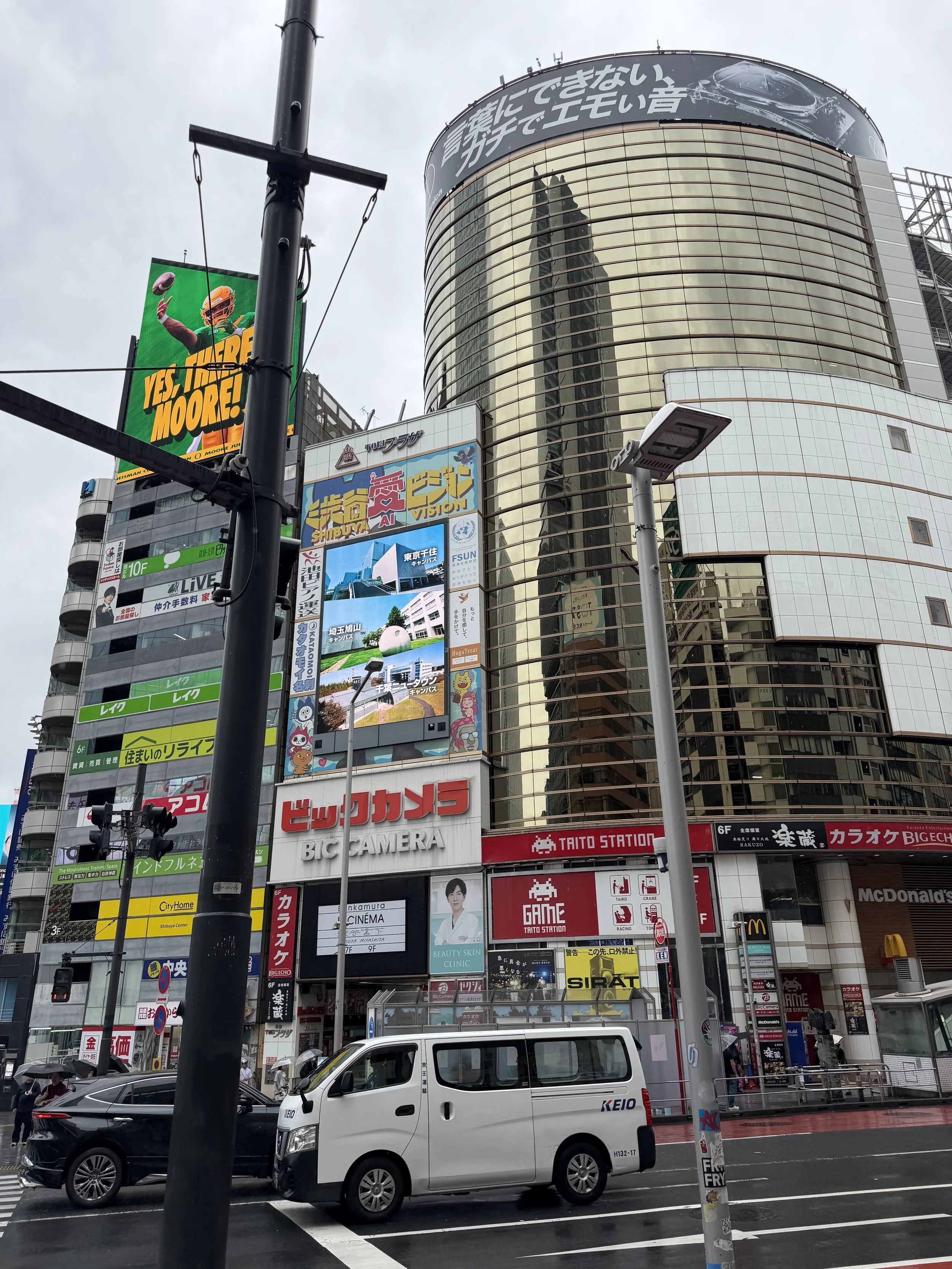
However, research suggests that this accessibility is not always consistent in everyday life. While large train stations, shopping centers, and other major public spaces often include elevators and accessible restrooms, many smaller restaurants, local shops, and older buildings still have barriers such as entrance steps, narrow walkways, and few — or sometimes no — accessible restroom facilities (Accessible Japan, n.d.; Voyapon, 2023). Researchers have also found that accessibility policies are carried out differently across cities and towns, and many older buildings are not required to make major accessibility upgrades. As a result, there can be a noticeable difference between the accessibility found in large public spaces and the places people visit every day, such as local businesses, restaurants, and schools (Cabinet Office of Japan, 2021; Takahashi & colleagues, 2021).
During my visit to Tokyo as a university student, I began noticing this distinction firsthand, which made me question how accessible daily life truly is for wheelchair users and individuals with chronic illnesses.
The first thing that really stood out to me was the lack of wheelchair-accessible restroom stalls outside of large shopping malls, transportation hubs, and amusement parks. Many restaurants, apartment buildings, schools (even modernized ones), and local stores did not appear to have them. Throughout my time in Tokyo, I also did not see a single wheelchair user. Of course, that does not mean wheelchair users do not exist in Japan. Instead, it made me wonder whether the built environment itself creates barriers that make it much harder for some people with disabilities to participate in everyday life.
For example, a friend told me about someone they knew with a chronic illness who experienced a medical episode and was unable to leave her apartment for an extended period because the building only had stairs. While this is only one person's experience, it made me think more critically about the accessibility of everyday spaces. Many buildings I visited relied entirely on stairs, creating challenges not only for wheelchair users but also for people with chronic illnesses, mobility impairments, or other medical conditions. It left me questioning how much of disability is created by a person's medical condition and how much is created by an environment that is not designed to meet diverse accessibility needs.
Before visiting Japan, I never really thought of my autonomic dysfunction as a disability. In the United States, I have access to elevators, accessible restrooms, and other accommodations that make it possible for me to navigate daily life without thinking much about my condition. Because of that, it rarely felt disabling. However, being in Japan made me experience my condition differently. For the first time, I felt like the environment itself was creating barriers that made everyday tasks much more difficult.
That experience helped me better understand one of the core ideas in disability studies: disability is not only shaped by a person's medical condition, but also by the environment they live in. An inaccessible environment can make an impairment far more limiting than it would otherwise be, while an accessible one can greatly reduce those barriers. During my time in Tokyo, I often felt like I had to overcome obstacles that I rarely face at home, and it left me wondering why everyday accessibility differs so much between countries.
I also want to be careful not to confuse my observations with conclusions. I spent a short time in Tokyo, and my experiences are only one perspective. However, they did leave me with questions. Is there a connection between Japan's strong emphasis on independence, efficiency, and social order and the way accessibility is designed in everyday spaces? Do cultural expectations influence what kinds of accommodations are considered necessary? I don't know the answer, but they are questions I found myself returning to throughout my time there.
When thinking about disability as a social construct, I also started thinking about how much Japan values discipline, order, and social awareness. As a foreigner, it was very noticeable how carefully people followed rules and moved through public spaces in an organized way. In many ways, this was beautiful to witness because there was a strong sense of respect for others. At the same time, it made me wonder what happens to people whose bodies do not allow them to move through the world in that same controlled and predictable way.
This is where disability becomes more than just a medical condition. If a society expects everyone to be independent, quiet, efficient, and physically capable at all times, then needing help, needing rest, moving slowly, or requiring accessible spaces can be treated as an inconvenience instead of a normal part of human life. To me, this raised a larger question: are some accessibility gaps caused not only by architecture, but also by cultural ideas about weakness, laziness, and what it means to be a “proper” or capable person?
As an American who eats burgers while walking down the street, gets shoved around on the New York City subway, and talks on the phone while walking, Japan's social expectations were a huge culture shock. I was amazed by the level of discipline and respect people showed for both themselves and those around them. It felt as though there was a shared understanding of how to move through public spaces in a way that respected everyone else. It was unlike anything I had ever experienced.
Throughout my time there, I learned that talking on the phone while riding the train or eating while walking is generally considered impolite. I also noticed that people often exchanged items with both hands and accompanied the gesture with a slight bow as a sign of respect. Even tipping at restaurants is uncommon because providing good service is already considered part of the job. I found these customs fascinating, and in many ways, I admired them. However, they also made me wonder whether such strong expectations around independence, efficiency, and self-discipline might unintentionally create additional challenges for people whose disabilities or chronic illnesses prevent them from meeting those expectations. I don't know whether these ideas are connected, but they left me asking an important question: How can a society maintain its incredible sense of respect and order while also creating environments that are more accessible and accommodating for everyone?
I want to be clear that I deeply admire many of these cultural values. The respect people showed for one another, the cleanliness of public spaces, and the shared sense of responsibility made me wonder why more countries don't embrace these same ideas. In many ways, it felt like a beautiful example of what a community can look like when people genuinely consider those around them.
At the same time, I found myself wondering whether there is a point where high social expectations can unintentionally make it harder for people whose bodies or minds function differently. How do we encourage respect and personal responsibility without creating an environment where asking for help or needing accommodations is viewed negatively? I don't have the answer, but it left me thinking about whether it is possible to combine the best of both worlds: a society built on kindness, respect, and consideration for others, while also embracing accessibility, flexibility, and compassion for people whose needs may look different.
I didn't leave Japan with answers — I left with questions. Before this trip, I thought accessibility was mostly about ramps, elevators, and accessible restrooms. Now, I see it as something much larger. Accessibility is also shaped by culture, by the expectations we place on one another, and by the environments we choose to build.
This experience also changed the way I understand my own disability. For most of my life, I rarely viewed my autonomic dysfunction as disabling because the environments around me generally allowed me to participate without much thought. During my time in Tokyo, that perspective changed. It reminded me that disability is not only about our bodies, but also about whether the world around us is designed to include them.
I still believe Japan has many lessons the rest of the world could learn from — its respect, cleanliness, and sense of collective responsibility are genuinely inspiring. At the same time, I hope conversations about accessibility continue to grow, because no society is perfect. Every culture has strengths worth celebrating and areas where it can continue to improve. If anything, this experience reminded me that the goal shouldn't be choosing between respect and accessibility. It should be finding ways for them to exist together.
Further Reading: If you're interested in learning more about disability accessibility in Japan, these are some of the resources that informed my reflections.
References
Accessible Japan. (n.d.). Accessible toilets in Japan. https://www.accessible-japan.com/accessible-toilets-in-japan/
Accessible Japan. (n.d.). Wheelchair accessible restaurants in Japan. https://www.accessible-japan.com/wheelchair-accessible-restaurants-japan/
Cabinet Office, Government of Japan. (2021). Annual report on the government measures for persons with disabilities (2021). https://www8.cao.go.jp/shougai/english/annualreport/2021/pdf/c6.pdf
Takahashi, K., Othman, S., & Inatani, M. (2021). Practical challenges of creating and managing the barrier-free basic plan for better accessibility in cities by local governments in Japan. ResearchGate. https://www.researchgate.net/publication/352144352_Practical_Challenges_of_Creating_and_Managing_the_Barrier-Free_Basic_Plan_for_Better_Accessibility_in_Cities_by_Local_Governments_in_Japan
Tokyo Metropolitan Government. (n.d.). What is a barrier-free toilet? https://www.daredemo-tokyo.metro.tokyo.lg.jp/en/feature/what-is-barrierfree-toilet/
Voyapon. (2023). Accessible restaurants in Japan. https://voyapon.com/accessible-restaurants-in-japan/